Neodustry
Measurement System Configurator
Grid Dimensions
Row:
Min.: 2 sensors
Column:
Min.: 2 sensors
Pitch:
Min.: 13 mm
This configurator allows you to define the basic parameters of a sensor grid and immediately see the resulting layout and physical dimensions.
-
Rows
Defines the number of sensor elements along the vertical direction of the grid. -
Columns
Defines the number of sensor elements along the horizontal direction of the grid. -
Pitch
The center-to-center distance between adjacent sensors, expressed in millimeters.
If no pitch value is provided, the system automatically calculates the maximum possible pitch so that the active measurement area fits within the allowed dimensions.
Sensor Grid
Width:
-
Height:
-
Pitch:
-
Heat Map
This visualization illustrates how the thermal map changes as a function of sensor count and sensor spacing.
It is intended to demonstrate resolution-dependent behavior rather than exact physical accuracy.
Actual measurement results may vary depending on environmental conditions, material properties, and system configuration.
LDU
The central intelligence of the system.
The LDU (Local Display Unit) is the central control and visualization component of the measurement system, designed to go far beyond simple data display. It acts as the “brain” of the system, combining measurement control, data processing, and user interaction in a single, intelligent unit.
Selected LDU variants feature a customizable user interface, allowing displayed screens, views, and functions to be tailored to specific application requirements. In these configurations, measurements can be started, stopped, and configured directly from the interface, providing intuitive and efficient system control.
The unit is designed for flexible and mobile operation. It can be powered by a power bank, enabling standalone and portable use, or connected to a PC for long-term operation, data access, or extended system integration. The LDU can be operated from both mobile devices (such as smartphones) and computers, providing platform-independent access and control.
The LDU is engineered for demanding environments and operates reliably within a temperature range of –35 °C to +70 °C under normal humidity conditions. Its robust design ensures stable performance in industrial and field applications alike.


Grid
The measurement surface
The Grid is the active measurement surface of the system, designed to deliver accurate and reliable temperature data while maintaining a high level of mechanical flexibility. Each sensor within the Grid is capable of measuring temperature on both sides, enabling precise thermal monitoring of surfaces and components in direct contact with the sensor network.
To ensure maximum adaptability, the sensors are interconnected using silicone-insulated wiring, allowing the Grid to remain highly flexible and to conform closely to complex or uneven surfaces. This construction enables consistent sensor contact and reliable measurements across a wide range of applications.
The measurement surface is surrounded by a protective yet flexible frame, engineered with the same design philosophy. The frame is optimized to withstand high mechanical loads and repeated use, while preserving the overall flexibility of the Grid. This balanced design ensures durability without compromising adaptability.
Integrated LED indicators are embedded directly into the sensors, serving both functional and visual purposes. One key application of the LEDs is mask visualization, allowing defined sensor areas to be highlighted and projected onto the inspected surface, thereby improving positioning, alignment, and measurement accuracy.


Web Application
FRESH
&NEW
Desktop Application

Need more power?
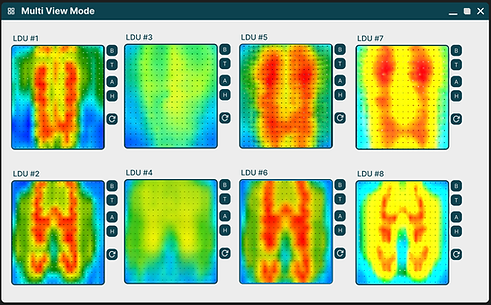
Record or analyze up to 8 devices simultaneously.